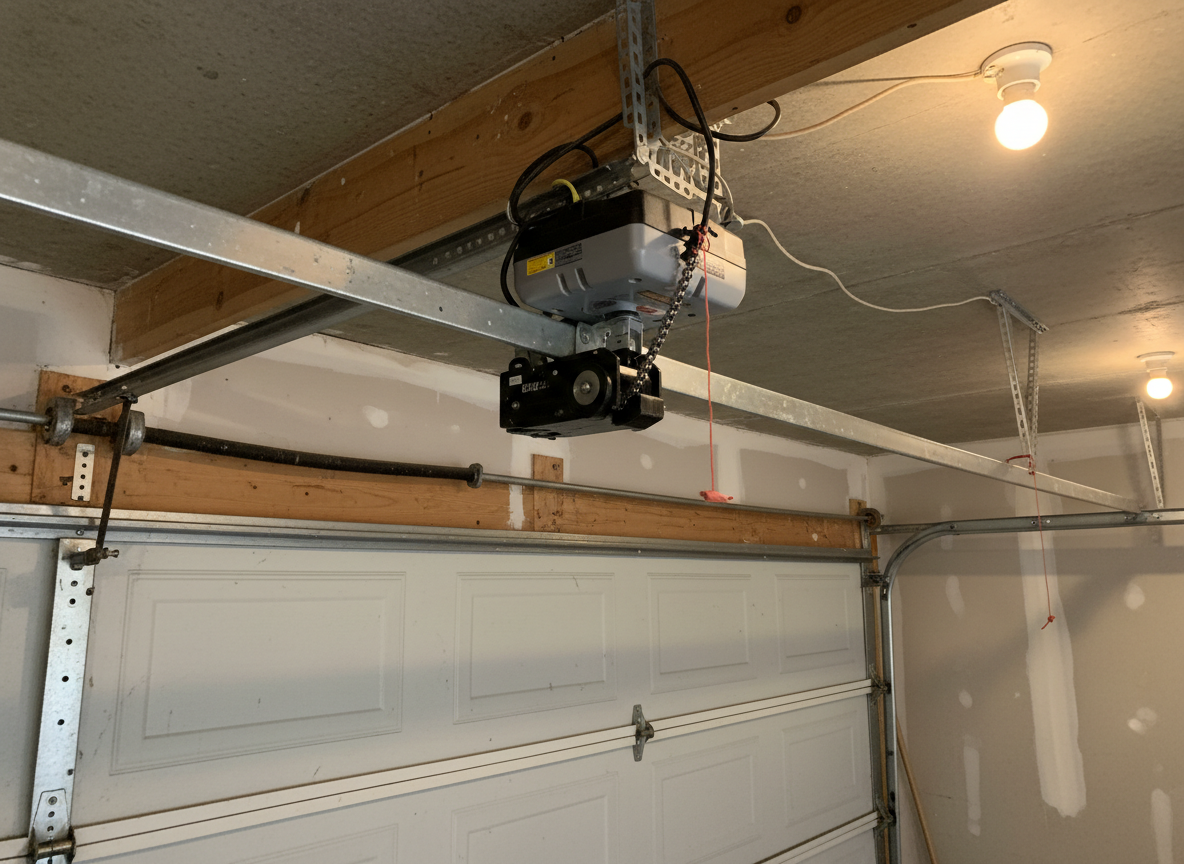
Most garage door openers use a chain, a belt or a screw to move a trolley along a rail, and that trolley pulls the door. The opener has a motor, a circuit board, a wall control, remotes and a pair of safety sensors near the floor. A problem in any one of those can look like a dead opener.
Common symptoms include no response from the remote or wall button, a remote that only works from close range, a motor that hums but the door does not move, a door that reverses before it closes, a light that blinks, and an opener that runs but only part way. Many openers flash a light or beep to signal a fault, and the manual lists what each pattern means.
Before you call, try the simple checks: make sure the opener is plugged in and the outlet has power, check the lock button on the wall control, replace the remote battery and clean the sensor lenses near the floor. The guides on an opener that is not working and a sensor that is not working walk through each one.
Then work out whether it is the opener at all. With the door closed, pull the release cord and try lifting the door by hand. If it lifts easily and stays up at waist height, the opener is the likely cause. If it is very heavy or sticks, the problem is the springs, cables or tracks, and you should stop and call rather than use the opener.
When you call, your call is connected to an independent local service provider. Tell it the make of the opener if you know it, what it does when you press the button and what you have already checked. Ask whether repair or replacement makes sense, and ask for the price before work starts.
How it works
- 1
Run the simple checks
Power, wall control lock button, remote battery and sensor lenses. Note what changes.
- 2
Test the door by hand
With the door closed and the opener released, see whether the door lifts easily. If it is heavy, stop.
- 3
Call and describe it
Share the make if you know it, the symptoms and what you checked. Ask for the price before work starts.